
The basics
What is RSV?
RSV is a very common virus that affects the airways. In adults it usually passes like an ordinary cold; but in babies in the first months of life it can reach the small airways of the lungs and cause severe illness.
Key message A substantial share of severe RSV disease and hospital admissions occurs in term infants previously considered healthy. RSV is not only a problem for high-risk groups.
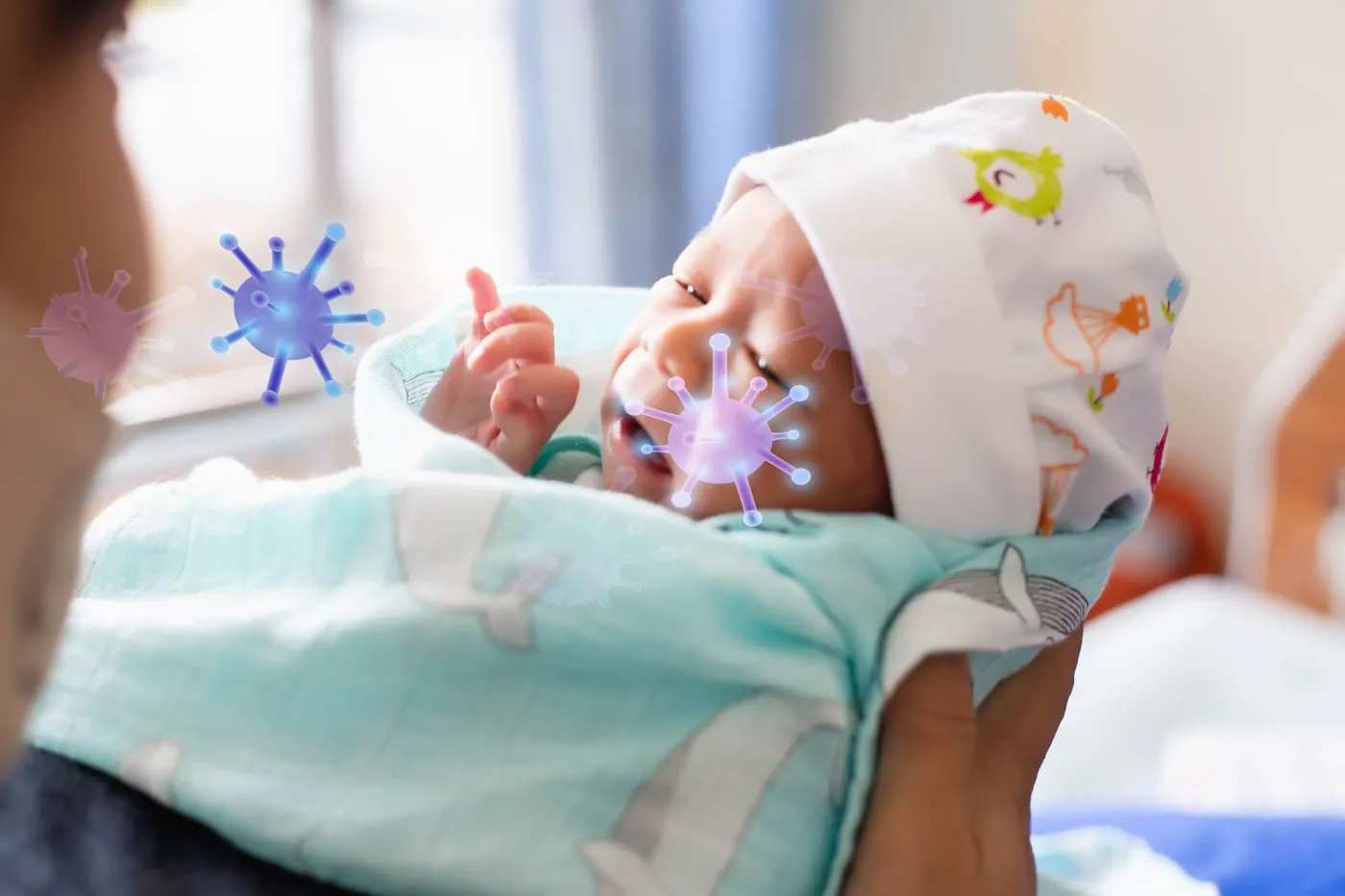
RSV stands for respiratory syncytial virus. In adults it usually presents with mild, cold-like symptoms. But in infants, young children and adults over 65 it can cause serious lower respiratory tract infections such as bronchiolitis or pneumonia. It remains one of the leading causes of hospital admission in infants.1
- 33 M RSV-associated lower respiratory tract infections in children under 5 in 2019 Li et al., 2022
- 3.6 M Of those cases, the number requiring hospital admission Li et al., 2022
- 6.6 M Cases in infants aged 0–6 months; 1.4 million of them were hospitalised Li et al., 2022
- 1 in 28 Estimated share of deaths in the 0–6 month group attributable to RSV Li et al., 2022
How common is it?
RSV is an extremely common infection in the first years of life.
The great majority of children encounter RSV at least once before their second birthday.26 Many infections are mild and confined to the upper airway; but in infants under one year the picture can be far more serious. In this age group bronchiolitis and pneumonia are among the leading reasons for emergency presentation and intensive care.3
Global modelling puts numbers on the scale: in 2019 there were around 33 million RSV-associated lower respiratory tract infections in children under five, some 3.6 million of which required hospital admission. A disproportionate share of that burden falls on early infancy.3 RSV is the leading cause of acute lower respiratory infection burden in the first year of life.13
Why is it more severe in infants?
Early infancy is a particularly fragile stage where three factors converge:
- An immature immune system.
- Narrower airways — swelling and secretions in the small airways obstruct an infant's breathing far faster than an adult's.
- Maternal antibodies that are not always enough — the protection transferred from the mother is not always sufficient against lower respiratory tract infection.
Together these make infection far more severe in the first six months of life.31 The first months are when both biological vulnerability and hospitalisation risk peak.
Why does the virus circulate continuously?
Two mechanisms explain why RSV affects such a broad infant population.
First, it is highly contagious. The virus spreads readily via droplets and close contact. During seasonal winter epidemics it circulates rapidly through the community, substantially increasing the chance that young children meet it early in life.1
Second, immunity is not lasting. The immune response to RSV infection does not confer complete or durable protection. People can therefore be infected repeatedly throughout life, and the virus maintains uninterrupted circulation in the population.4 Having had it once does not mean you will not have it again.
What conditions does RSV cause?
-
Upper respiratory infection
The most common picture. Runny nose, congestion, cough, sneezing, fever. Usually resolves on its own within a week or two.5
-
Pneumonia
Infection of the lung tissue. Pneumonia was found in 59.8% of RSV cases admitted to intensive care in Türkiye.12
Diagnosis and treatment
Diagnosis rests on clinical suspicion and laboratory confirmation. In current practice rapid antigen tests and nucleic acid amplification tests (PCR) are the principal methods.8
There is no approved specific antiviral treatment for RSV infection. Management is essentially supportive: adequate oxygenation, fluids and, where required, mechanical ventilation.9 Most infants admitted to hospital improve with this supportive care and are discharged within a few days.7
Sources
- Mazur, N. I., Higgins, D., Nunes, M. C., Melero, J. A., Langedijk, A. C., Horsley, N., Buchholz, U. J., Openshaw, P. J. M., Pollard, A. J., & Nair, H. (2024). Respiratory syncytial virus. The Lancet, 403(10439), 1541–1555. doi.org/10.1016/S0140-6736(24)00314-2
- Canadian Paediatric Society. (2024, 6 Kasım). Respiratory syncytial virus (RSV) prevention strategies for infants and children. cps.ca/en/documents/position/rsv-prevention-strategies
- Li, Y., Wang, X., Blau, D. M., Caballero, M. T., Feikin, D. R., Gill, C. J., Madhi, S. A., Omer, S. B., Simões, E. A. F., Campbell, H., ve ark., & Nair, H. (2022). Global, regional, and national disease burden estimates of acute lower respiratory infections due to respiratory syncytial virus in children younger than 5 years in 2019: A systematic analysis. The Lancet, 399(10340), 2047–2064. doi.org/10.1016/S0140-6736(22)00478-0
- Jha, A., Jarvis, H., Fraser, C., Openshaw, P. J. M., & Semple, M. G. (2024). Respiratory syncytial virus infection. Clinical Microbiology Reviews, 37(1), e00003-23. doi.org/10.1128/cmr.00003-23
- Centers for Disease Control and Prevention (CDC). Symptoms and care of RSV. www.cdc.gov/rsv/symptoms/index.html · 2026-08-04
- Centers for Disease Control and Prevention (CDC). How RSV spreads. www.cdc.gov/rsv/causes/index.html · 2026-08-04
- Centers for Disease Control and Prevention (CDC). RSV in infants and young children. www.cdc.gov/rsv/infants-young-children/index.html · 2026-08-04
- Asseri, A. A. (2025). Respiratory syncytial virus: A narrative review of updates and recent advances in epidemiology, pathogenesis, diagnosis, management and prevention. Journal of Clinical Medicine, 14(11), 3880. doi.org/10.3390/jcm14113880
- Medscape. (2025). Respiratory syncytial virus (RSV) infection treatment & management. Erişim: 25.05.2026. emedicine.medscape.com/article/971488-treatment
- Wildenbeest, J. G., Korsten, K., & Bont, L. J. (2022). The burden of respiratory syncytial virus in healthy term-born infants: A systematic review and meta-analysis. Infectious Diseases and Therapy, 11, 1891–1913. doi.org/10.1007/s40121-022-00666-5
- Dallagiacoma, G., Pierantoni, L., Lanari, M., & Pession, A. (2025). Risk factors for severe outcomes of respiratory syncytial virus infection in children. The Lancet Regional Health – Europe, 41, 100923. doi.org/10.1016/j.lanepe.2024.100923
- Çoban, Y., Evren, G., Yıldızdaş, D., Zengin, N., Bal, L., Kendirli, T., ve ark., & Dinleyici, E. Ç. (2026). Burden, risk factors, and outcomes of respiratory syncytial virus (RSV) infection in pediatric intensive care units in Türkiye (RSVP Study 2020–2024). BMC Pediatrics, 26(1), Article 298. doi.org/10.1186/s12887-026-06562-7
- Shi, T., McAllister, D. A., O'Brien, K. L., Simões, E. A., Madhi, S. A., Gessner, B. D., ve ark., & Nair, H. (2017). Global, regional, and national disease burden estimates of acute lower respiratory infections due to respiratory syncytial virus in young children in 2015: A systematic review and modelling study. The Lancet, 390(10098), 946–958. doi.org/10.1016/S0140-6736(17)30938-8
The information on this site is for general guidance only and does not replace examination, diagnosis or treatment by a clinician.