
For parents
Symptoms and warning signs
RSV looks like an ordinary cold at first. What matters is that it can worsen within a few days. This page explains how symptoms progress and which signs mean you should not wait.
Key message The early signs of RSV — particularly wheezing and feeding difficulty — are often read as an ordinary cold. That misreading can delay seeking care.
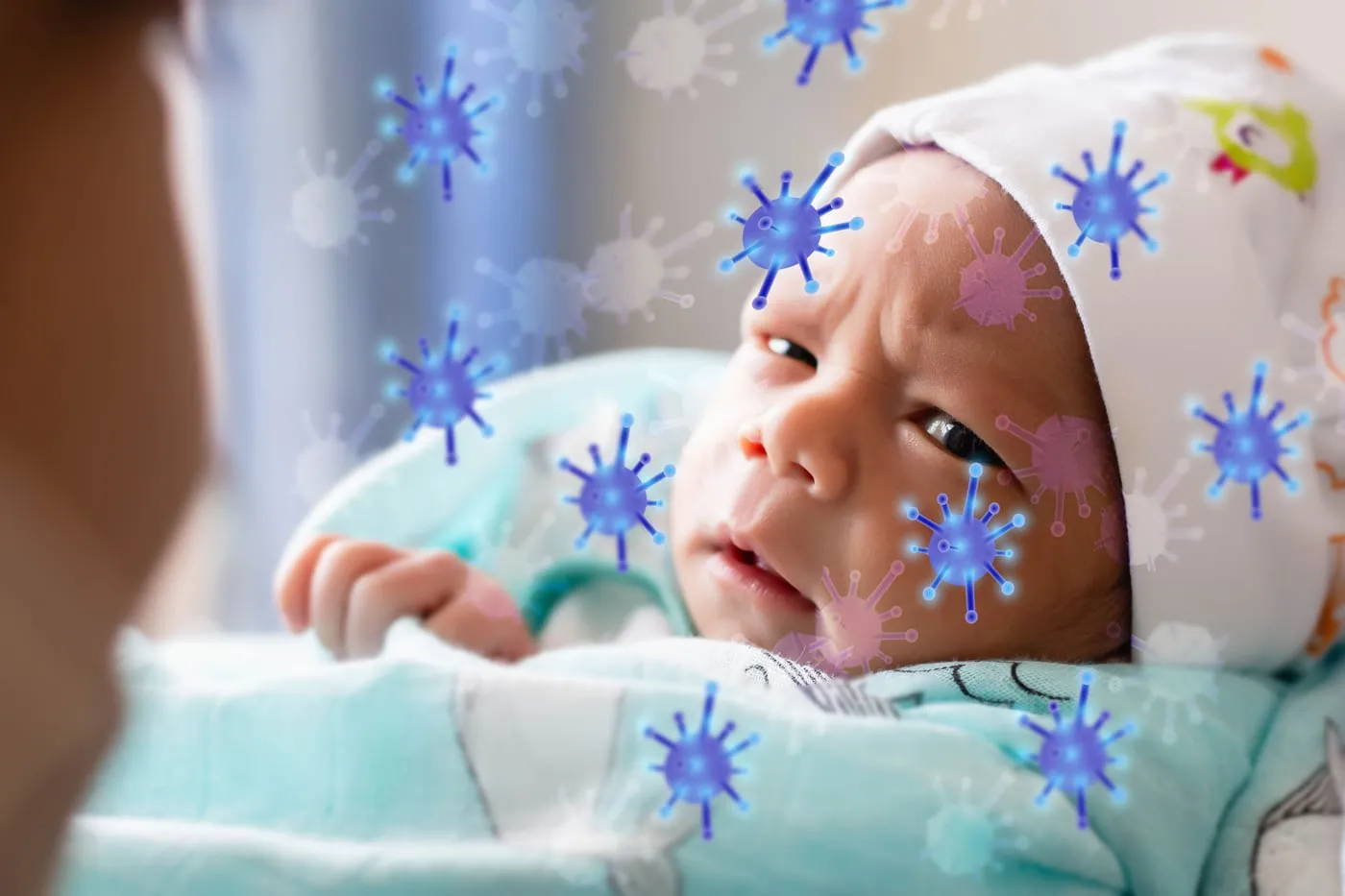
This list is based on the criteria for urgent care in infants with RSV set out by the US Centers for Disease Control and Prevention (CDC) and the American Academy of Pediatrics (AAP).1210
What are the symptoms of RSV?
People infected with RSV usually show symptoms 4 to 6 days after infection. Typical symptoms are:1
- Runny nose
- Congestion
- Decrease in appetite
- Coughing
- Sneezing
- Fever
- Wheezing
One detail matters: these symptoms appear in stages, not all at once.1 However mild the first day looks, the picture can change over the days that follow.
Symptoms can look different in infants
Adults can sometimes have RSV without any symptoms; infants who get RSV almost always show symptoms.2 But those symptoms can look different from an adult's.
Early symptoms in infants and young children
- Nose
- Runny nose
- Feeding
- Eating or drinking less
- Breathing
- Cough — may progress to wheezing or difficulty breathing
Symptoms in babies under 6 months
The picture can be quieter still in this age group
- Behaviour
- Irritability
- Activity
- Decreased activity
- Feeding
- Eating or drinking less
- Breathing
- Apnoea — pauses in breathing for more than 10 seconds
How long does it last?
Most RSV infections go away on their own in a week or two.1 But RSV can cause serious illness in some people.
Contagiousness is a separate matter. People with RSV are usually contagious for 3 to 8 days and may become contagious a day or two before symptoms start. Some infants and people with weakened immune systems can continue to spread the virus for 4 weeks or longer, even after symptoms stop.3
What does severe RSV illness look like?
Most of the time RSV causes a mild, cold-like illness, but it can also cause severe illness such as bronchiolitis (inflammation of the small airways in the lung) and pneumonia (infection of the lungs).2
Infants who are hospitalised may require oxygen, intravenous fluids if they are not eating and drinking, and in some cases a machine to help with breathing. Most improve with this supportive care and are discharged in a few days.2
In a multicentre study of 646 children treated in paediatric intensive care units in Türkiye between 2020 and 2024, pneumonia was found in 59.8% and bronchiolitis in 38.1%; 25.5% required invasive mechanical ventilation.7
Why does care get delayed?
A parent's or carer's ability to recognise the signs of illness and seek care in time is critical to infant survival.4
The early signs of RSV — particularly wheezing and feeding difficulty — can often be interpreted as those of an ordinary cold. That misreading delays care-seeking. Maternal education and adequate health literacy play a directly determining role in this process.9
Access to care depends on more than the existence of a health service: recognising the signs, appreciating the risk, deciding to present, and physically reaching a facility are all part of a multifactorial social process.4
Sources
- Centers for Disease Control and Prevention (CDC). Symptoms and care of RSV. www.cdc.gov/rsv/symptoms/index.html · 2026-08-04
- Centers for Disease Control and Prevention (CDC). RSV in infants and young children. www.cdc.gov/rsv/infants-young-children/index.html · 2026-08-04
- Centers for Disease Control and Prevention (CDC). How RSV spreads. www.cdc.gov/rsv/causes/index.html · 2026-08-04
- Sreeramareddy, C. T., Shankar, R. P., Sreekumaran, B. V., Subba, S. H., Joshi, H. S., & Ramachandran, U. (2006). Care seeking behaviour for childhood illness — a questionnaire survey in western Nepal. BMC International Health and Human Rights, 6(1), 7. doi.org/10.1186/1471-2458-6-7
- Medscape. (2025). Respiratory syncytial virus (RSV) infection treatment & management. Erişim: 25.05.2026. emedicine.medscape.com/article/971488-treatment
- Asseri, A. A. (2025). Respiratory syncytial virus: A narrative review of updates and recent advances in epidemiology, pathogenesis, diagnosis, management and prevention. Journal of Clinical Medicine, 14(11), 3880. doi.org/10.3390/jcm14113880
- Çoban, Y., Evren, G., Yıldızdaş, D., Zengin, N., Bal, L., Kendirli, T., ve ark., & Dinleyici, E. Ç. (2026). Burden, risk factors, and outcomes of respiratory syncytial virus (RSV) infection in pediatric intensive care units in Türkiye (RSVP Study 2020–2024). BMC Pediatrics, 26(1), Article 298. doi.org/10.1186/s12887-026-06562-7
- Li, Y., Wang, X., Blau, D. M., Caballero, M. T., Feikin, D. R., Gill, C. J., Madhi, S. A., Omer, S. B., Simões, E. A. F., Campbell, H., ve ark., & Nair, H. (2022). Global, regional, and national disease burden estimates of acute lower respiratory infections due to respiratory syncytial virus in children younger than 5 years in 2019: A systematic analysis. The Lancet, 399(10340), 2047–2064. doi.org/10.1016/S0140-6736(22)00478-0
- Murphy, C., MacLeod, W. B., Forman, L. S., Mwananyanda, L., Kwenda, G., Pieciak, R. C., Mupila, Z., Thea, D., Chikoti, C., & Yankonde, B. (2021). Risk factors for respiratory syncytial virus–associated community deaths in Zambian infants. Clinical Infectious Diseases, 73(Suppl 3), S187–S192. doi.org/10.1093/cid/ciab165
- American Academy of Pediatrics (Caserta, M. T., & Jones, A.). RSV: When it’s more than just a cold. HealthyChildren.org. www.healthychildren.org/English/health-issues/conditions/chest-lungs/Pages/RSV-When-Its-More-Than-Just-a-Cold.aspx · 2026-08-05
The information on this site is for general guidance only and does not replace examination, diagnosis or treatment by a clinician.